Himalayas Day 6 – Kyangjuma to Phortse

I awoke on day five of the trek proper with a nervous feeling for two reasons. Firstly I was worried that my stomach had not settled properly after yesterday’s diarrhoea, and secondly I was concerned about altitude, as yesterday I had my first altitude headache, and had taken paracetamol to alleviate it.

To help with the first of the above I had been given two sachets of hydration salts by Ngima, our guide, and I had drunk most of this with one and a half litres of water, during the night. The effects of the water, coupled with the fact that I am taking Diamox for the altitude, made me want to pee like a Russian racehorse, and then about every fifteen minutes. Trouble is, that even in a teahouse, the temperature gets pretty cold at night (we are talking below zero), and so you really don’t want to get out of your sleeping bag if you can avoid it. I managed in the end with just one trip at about 3am and a lot of willpower.

I felt thankfully actually better on both counts by the time I had looked out of the window. We were greeted by perfectly clear skies and a view of the colossal and majestic Ama Dablam (22,500 feet), staring right at us. This view could clear the sickest and sorriest of souls I can promise you.

After a breakfast of the now ubiquitous watery porridge and toast, we were set for the off at about 7.30am. Today was to be a short day in terms of distance, and practically speaking our second acclimatisation day since reaching Namche Bazar. This was great as far as I am concerned, as there is no such thing as either walking too slowly or too much acclimatisation for my liking.

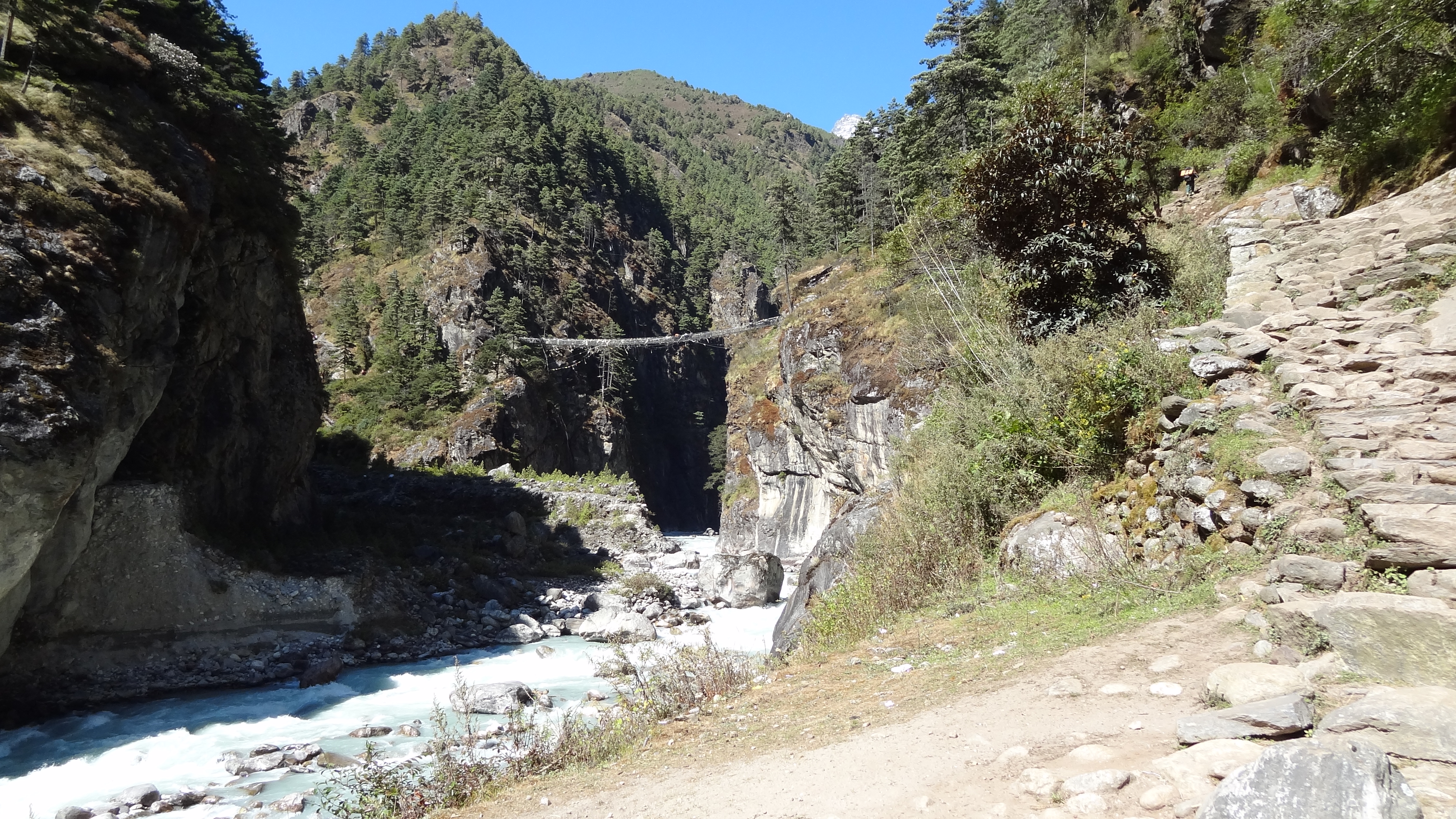
After a brief group photograph (see below) we set off first downhill, and then crossed the river to begin a steep uphill climb towards Mong La, the highest place we have been to yet at 3,975m (13,117ft).
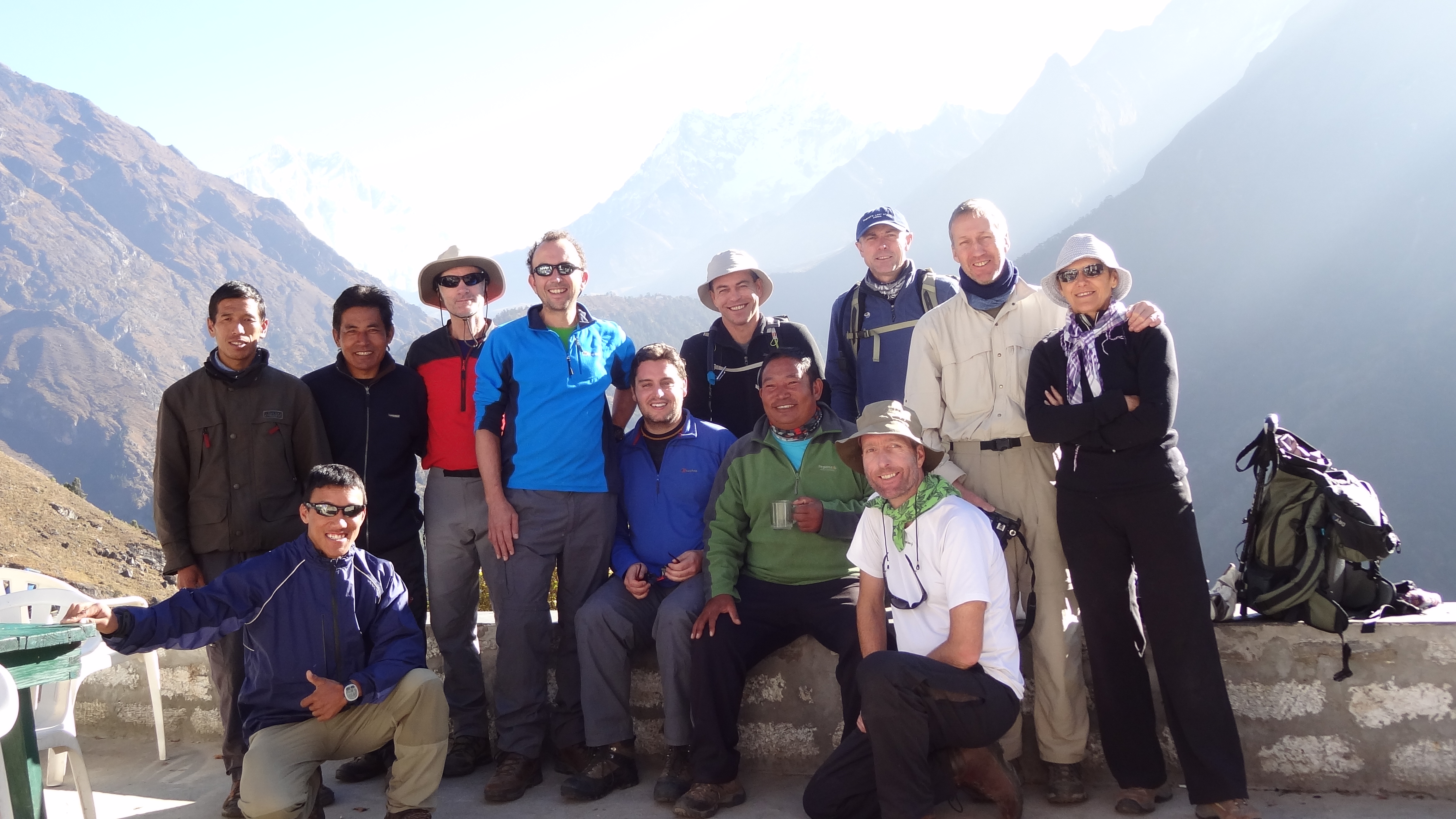
Kjangjuma, Solokhumbu, Himalayas. Life doesn't get an awful lot better than this.

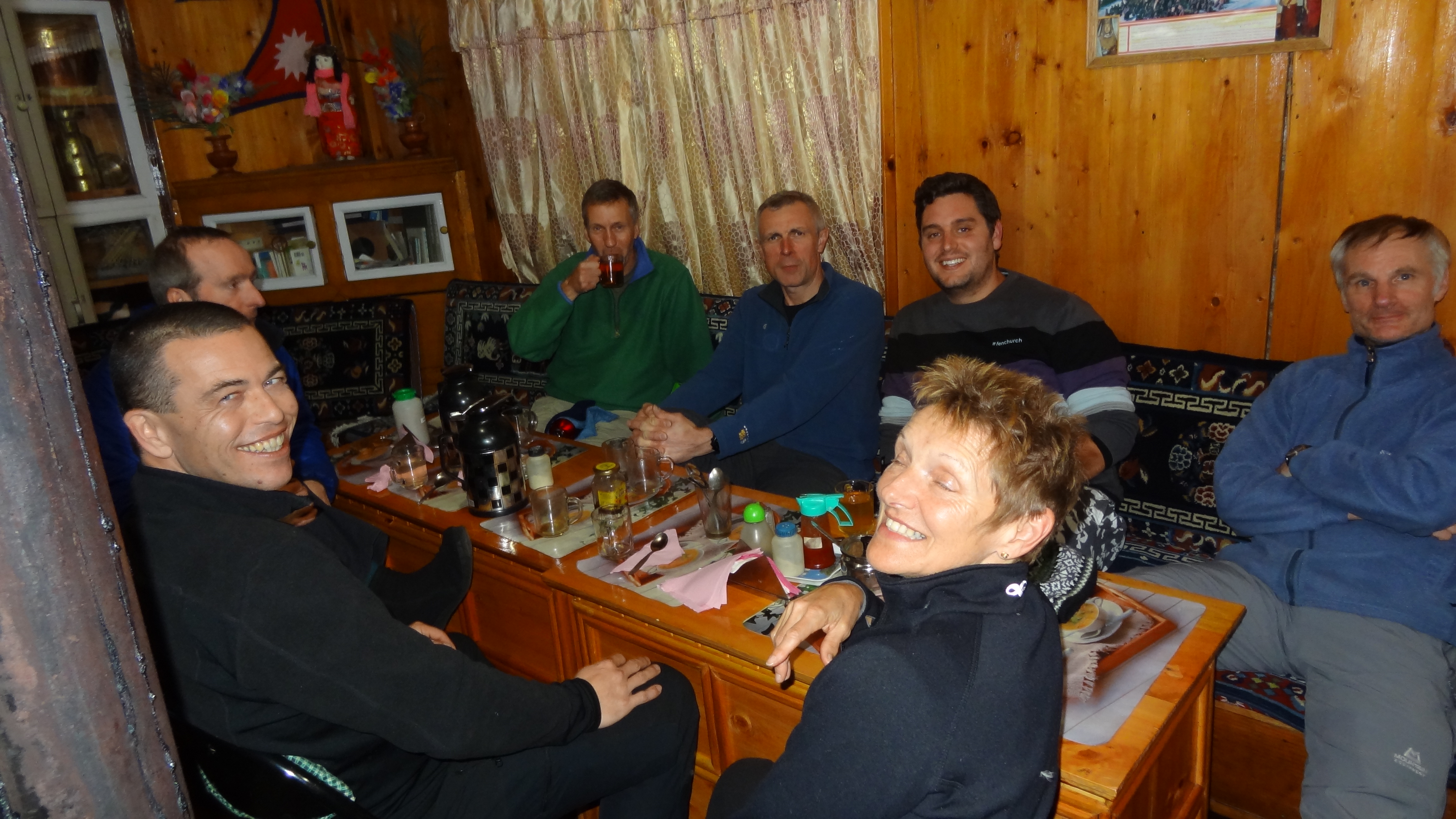
So in the above you will see, from left to right, Ngawang, Ngima (kneeling), Ram, Rob, yours truly, Ben, Stefan, Pasang, Tony, Bruce (kneeling), Dave, and Mo.

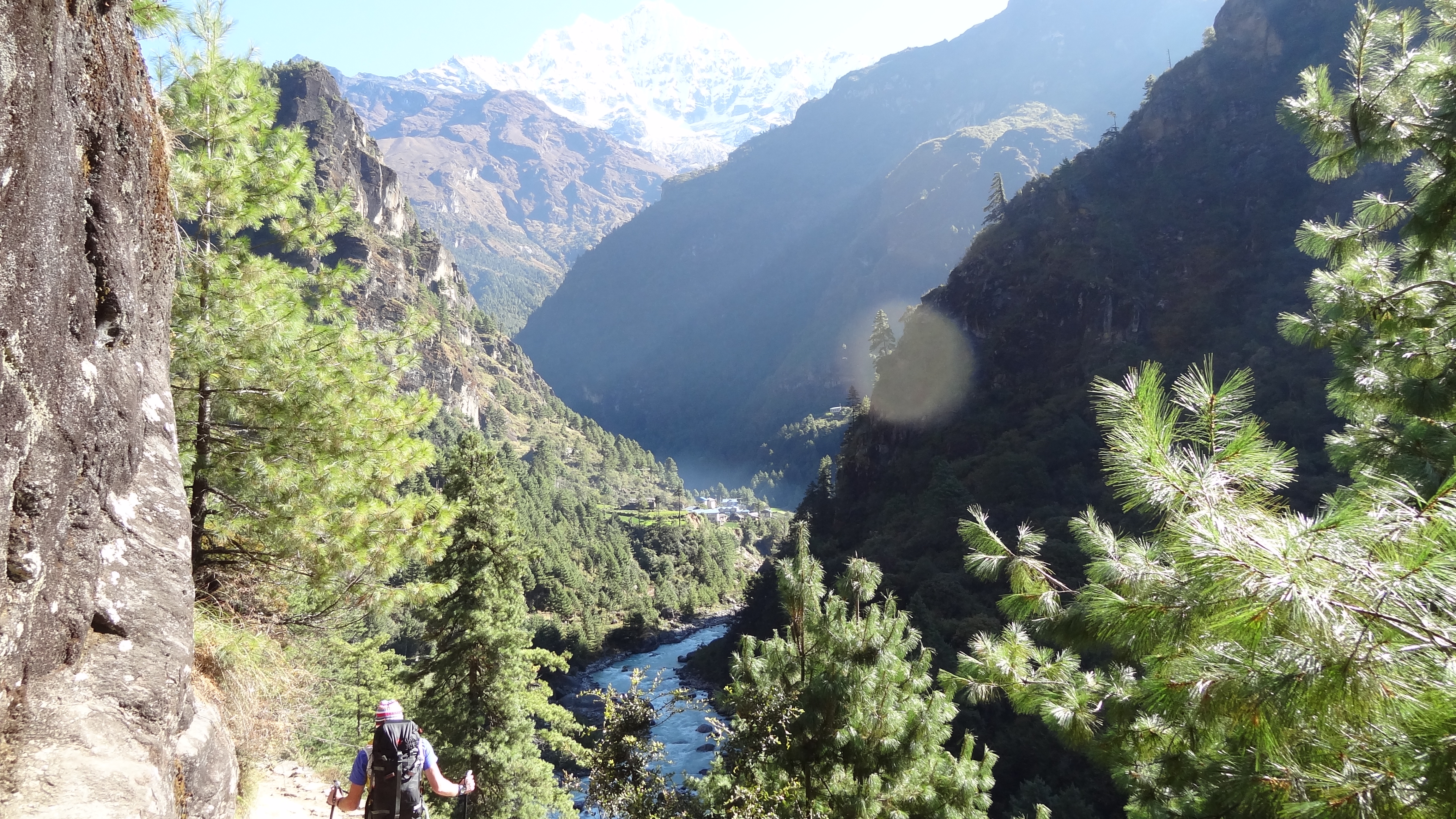
The walk is the most picturesque we have been on yet. There were simply staggering views of Ama Dablam, which has now surpassed the Matterhorn as my most photographed mountain (are you reading this Paul?). But better, there is just magnificent scenery all around us. We can see the trail that we will start to take in two days time towards Dingboche, we can see the Gokyo River far below us, we see snow capped Himalayan peaks stretching into forever. It is magical.
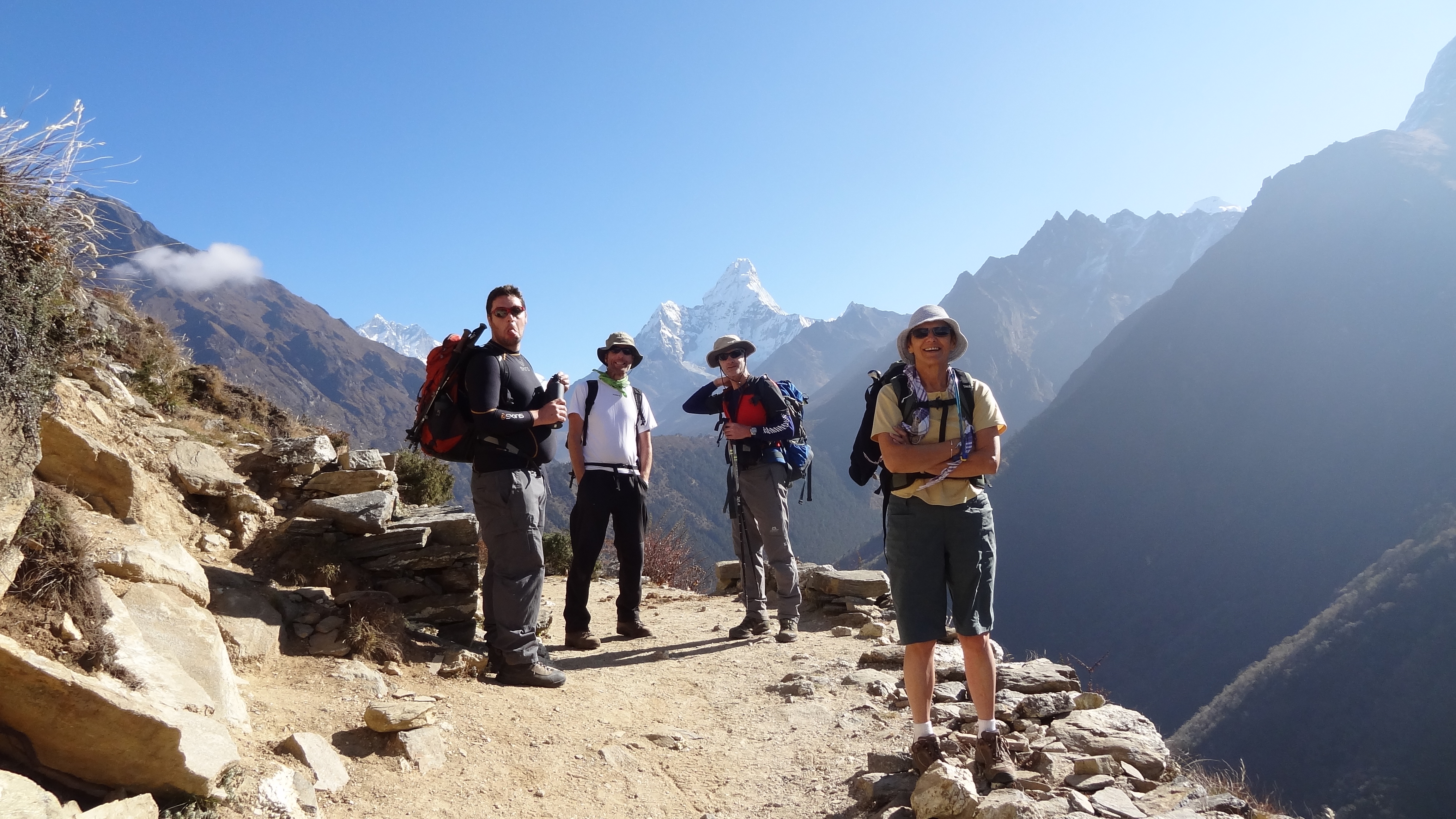
On the way towards Mong La

We have a tea stop at Mong La, and are afforded the best views yet. Just look at this:

Staring in wonderment at the majesty of the Himalayas
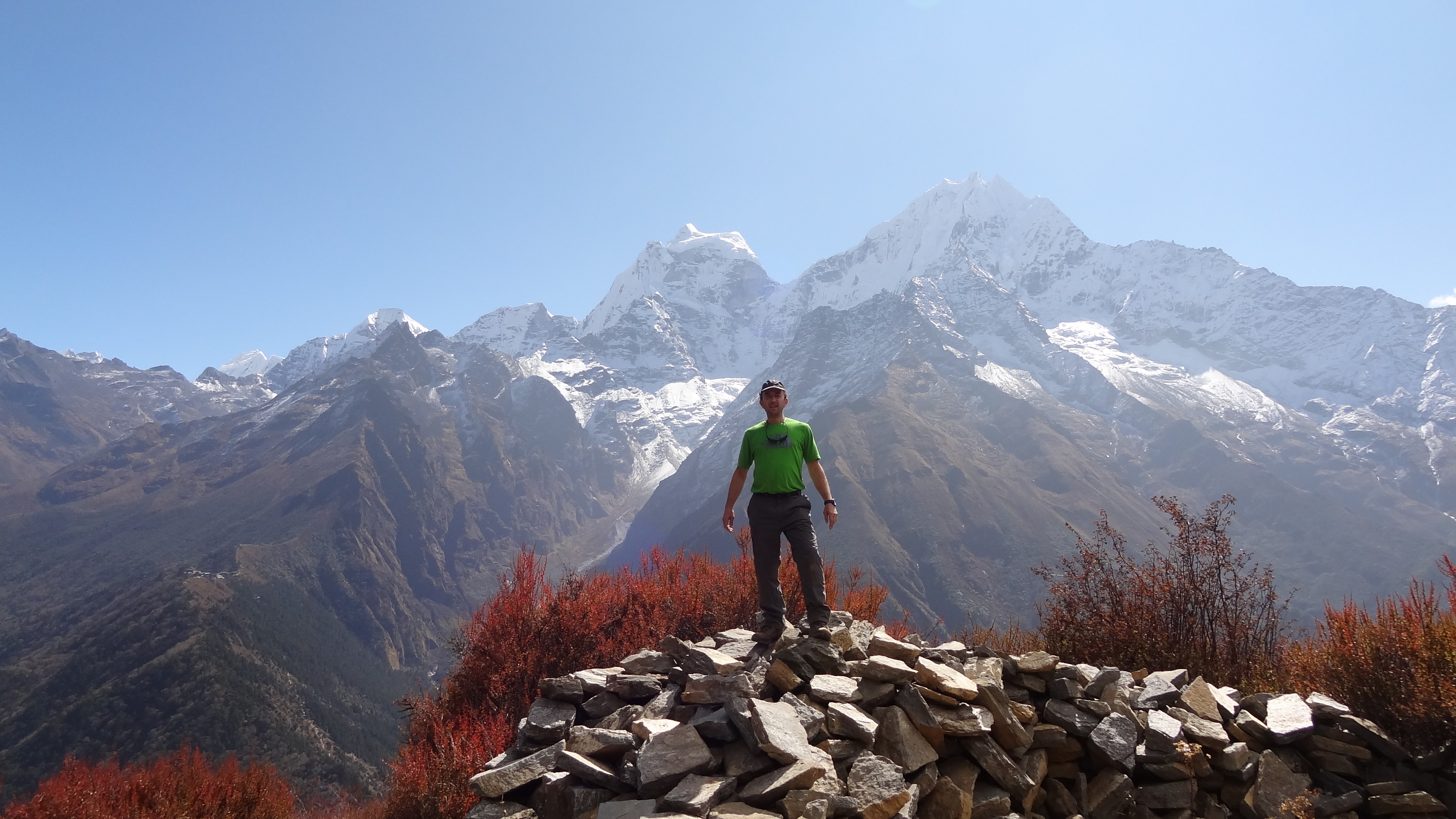
I just don't need words to describe this.

This is by far the best view I have seen yet. I stand here and get all misty eyed all over again. I could have stayed there for days on end.

After our rest we descend steeply around 300m to a break in the Gokyo River, at a tiny hamlet called Phortse Tenga. On the way down we see mountain goats, pheasant, a peacock, and a musk deer! I had not expected to see anything but Yaks on this journey, and so this is a huge bonus.

Mountains goats below our path

Following lunch we have to gain the majority of the altitude we have just lost, and walk up the other side of the Gokyo River. Again it is stunning. The trees are lichen covered, and the sun shines like a perfect summers day. As we ascend we are afforded a view of Cho Oyu behind us, the sixth highest mountain in the world at 26,900 feet. It looks even bigger than that, if that is at all possible. How good can the views around here get? I want to stop every twenty yards at times to take photographs, as it is just so ridiculously wonderful.

Lichen covered trees looking back up the Gokyo Valley

In fact let’s just pause for thought a minute here. Imagine you are walking up a gorgeous path, with a glacial river in the valley below you coming off Mount Everest. You have deer, pheasant, mountain goats around you. The sun is shining, the air is still, and for miles in any direction you see nature at its most majestic, and that is an understatement, including the tallest mountains in the world. Do you laugh or cry? I can tell you I did a pretty damn good job of doing both at the same time this day.

Eventually we reach our destination of Phortse, at 3,840m. This will be the highest we have yet slept, but I feel now comfortable at this altitude. Our guide Ngima is brilliant at a practically making us go as slowly as we wish. Seven of the eight are happy with this, but one, Stefan, wants to get ahead most of the time, and I really hope for his sake that he doesn’t pay for it as we get higher.
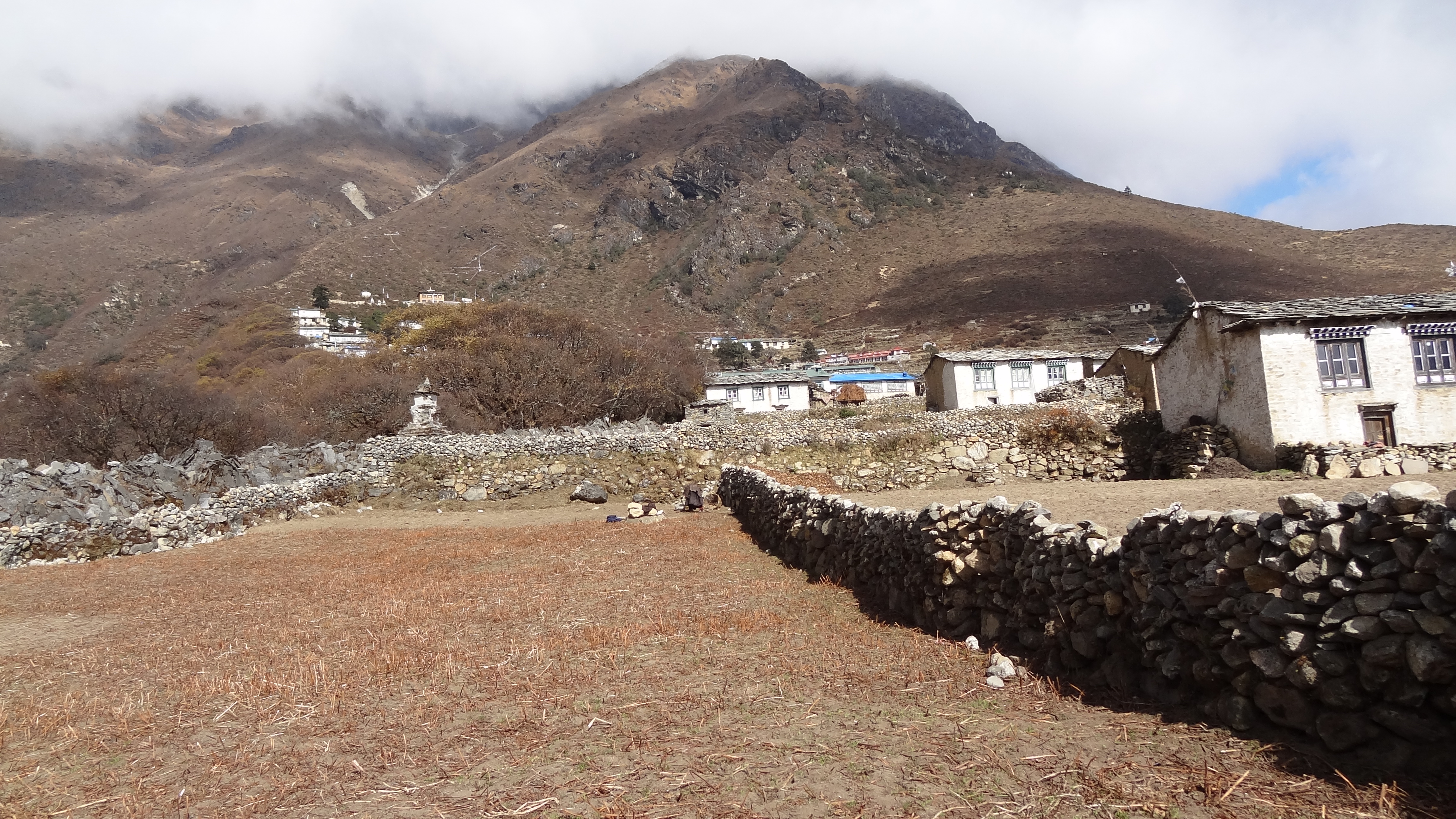
The settlement of Phortse, at 3,900m

The one thing that I have learned as possibly my most valuable lesson in the mountains is that you have absolutely nothing to gain, and possibly everything to lose, by going up too quickly. That is perhaps an excuse, or a justification for the fact that I am probably the slowest of the whole group and lingering at the back most of the time, but that is just how it is, and doesn’t bother me one iota. I am just happy (the understatement of all time) to be here.

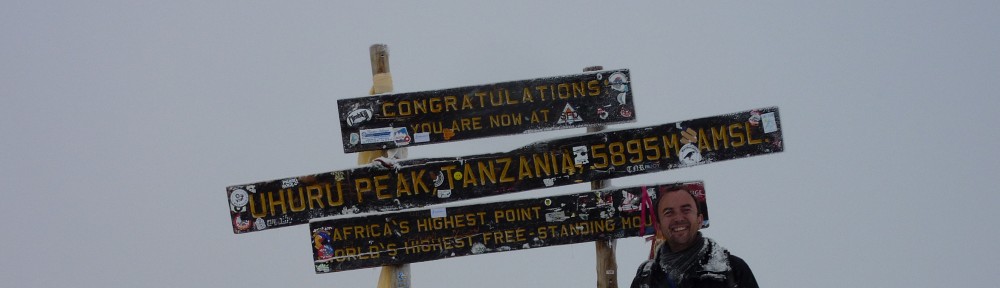
Aside from that fact, by going quickly you don’t get to stop, look up, and take in the sights like we did today. There are always things above you, around you, and below you. They are to be treasured. I am reminded of what someone told me when I did Kilimanjaro, which was ‘the worst thing you can do is put your head down and end up looking at the boots of the person in front of you – stop, look around, take it all in!’.

After we arrived at our lodge, the Namaste Lodge, there was a huge treat in store – a shower! The shower consisted of standing in an outside cubicle under a bucket of hot water, but the word hot was all that mattered, and it was my first shower in four days, so it was hugely welcome. In fact to have a shower you first ask the kitchen staff at the lodge to boil some water for you. They then take a big kettle, climb the ladder outside and fill up the bucket on the roof of the hut below. You then pull a chain inside and the water comes down. It works!
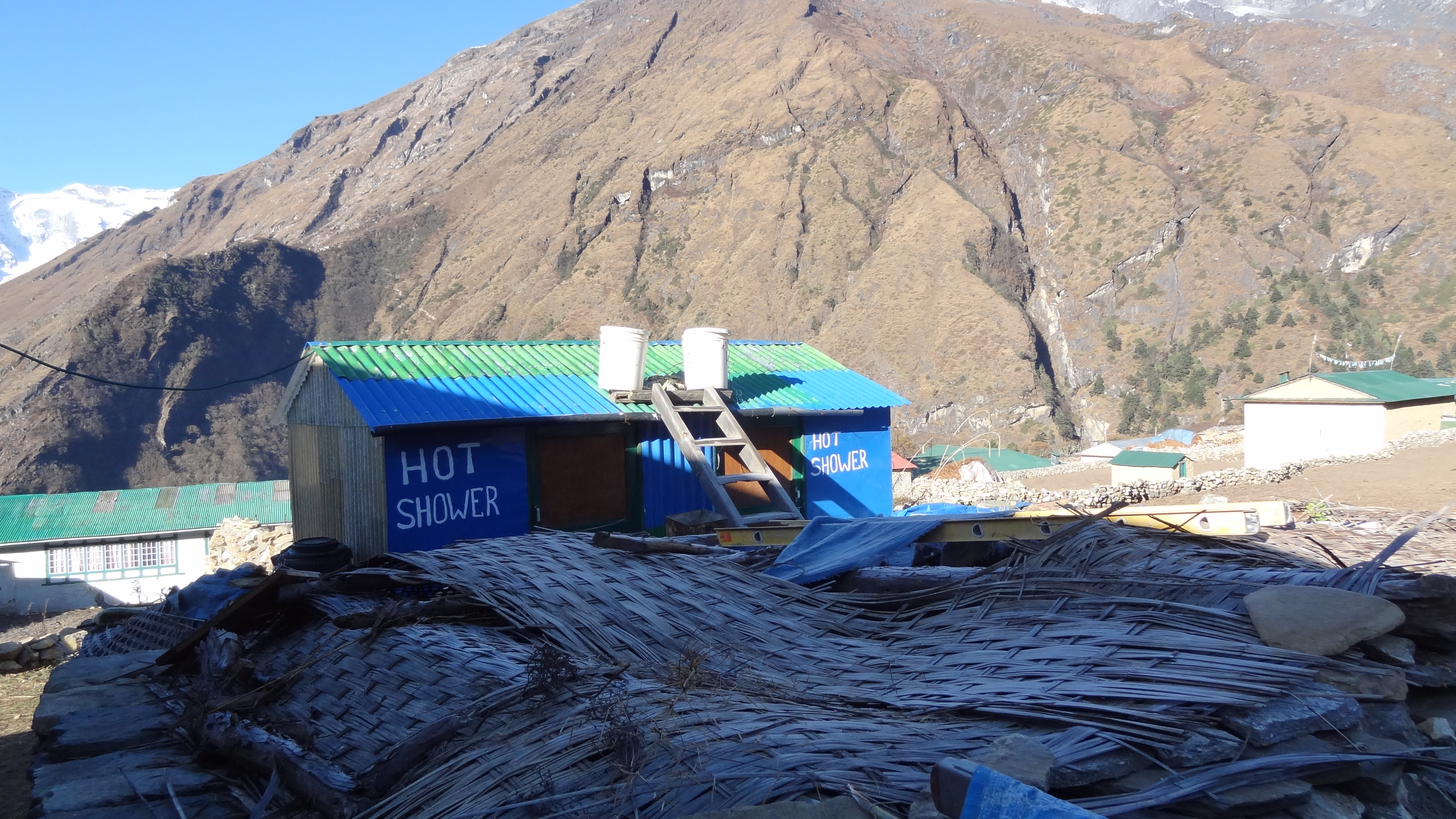
It is about -5 degrees outside, but the water is in fact hot from those buckets!
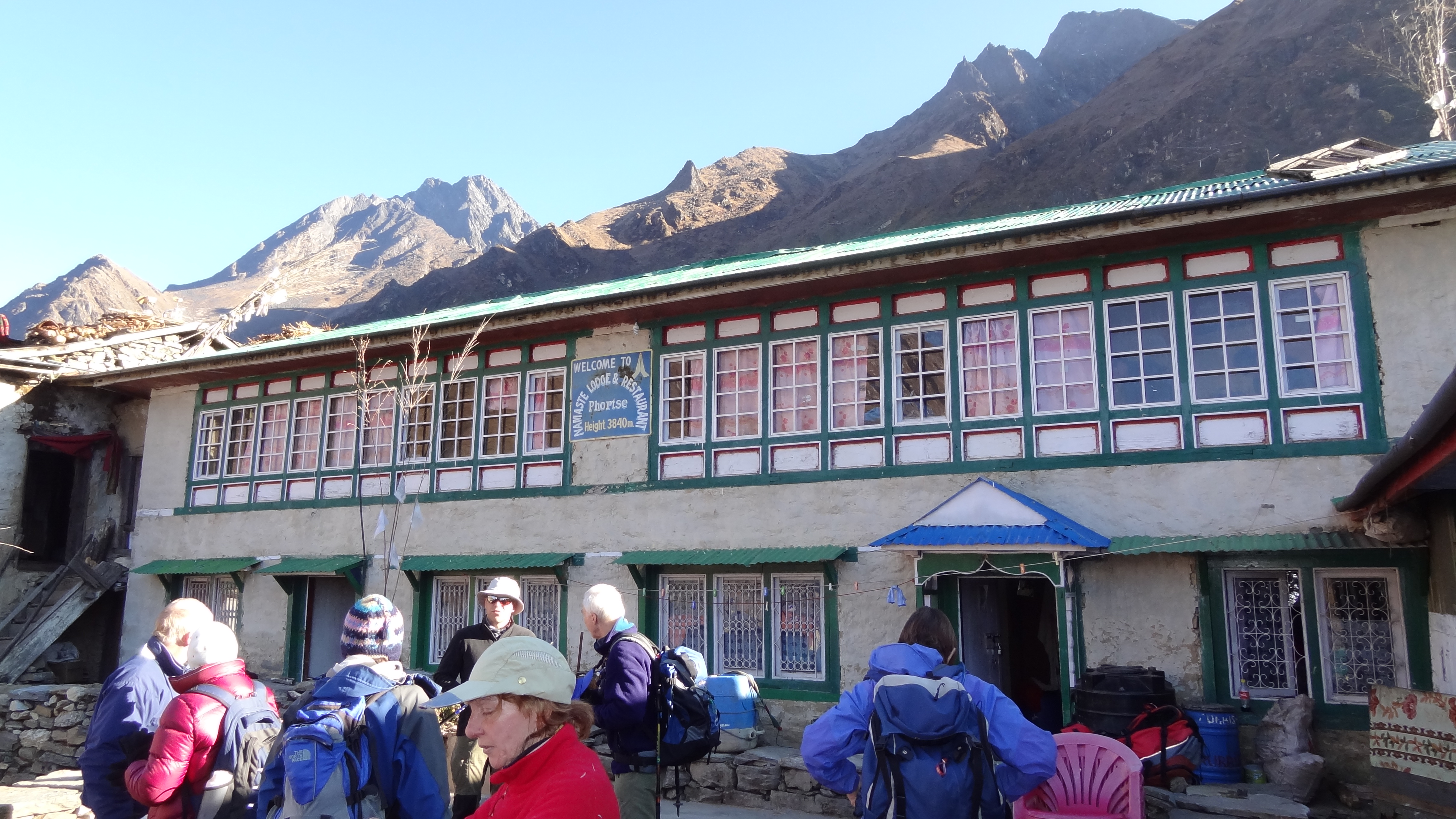
The Namaste Lodge in Phortse
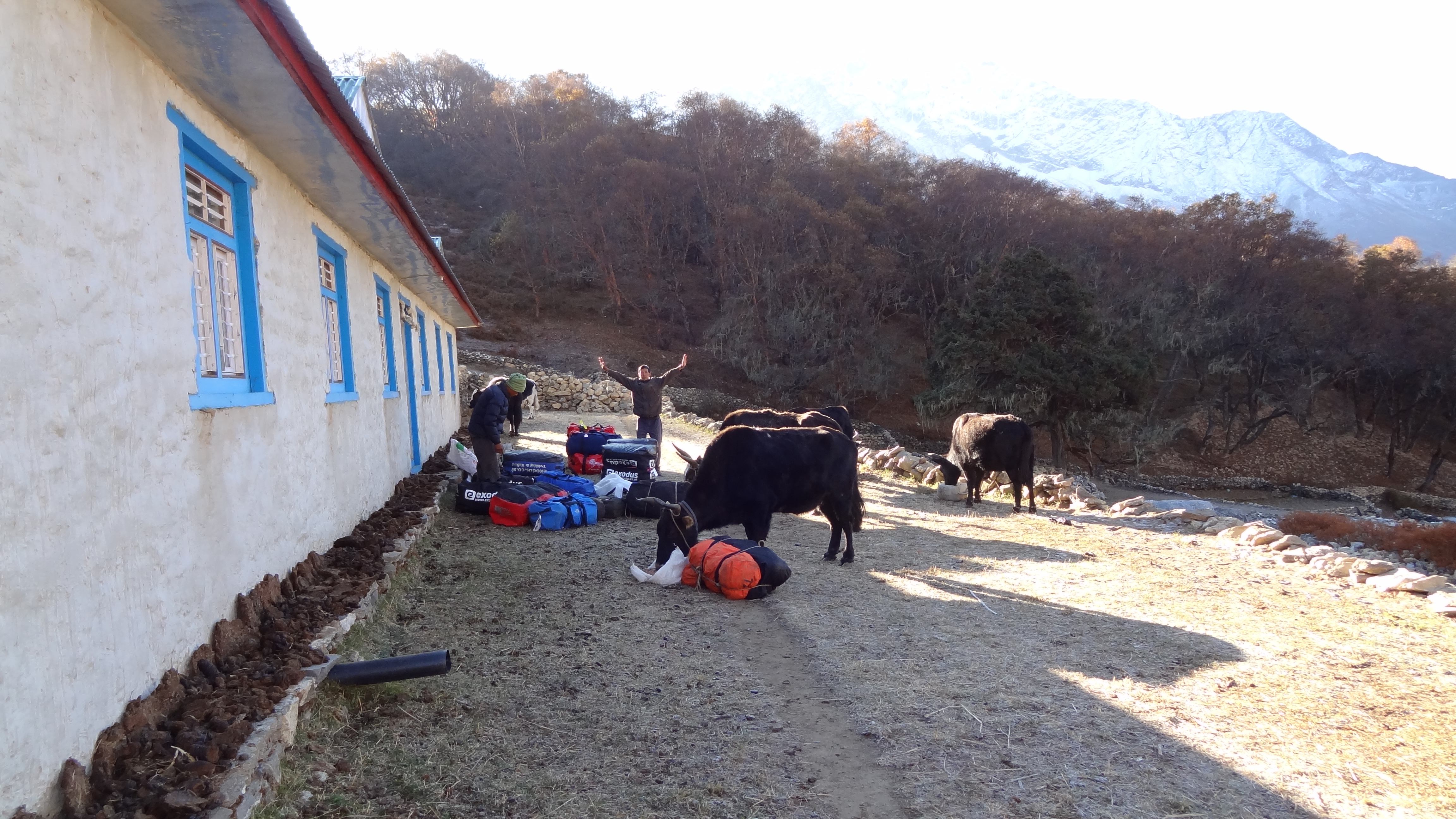
The yaks arrive with our bags in Phortse

You may notice that up against the wall in the above picture is some brown stuff. That is in fact yak dung. They dry out the pats in the sun, and then use it for both heating the lodge dining room, and also for cooking – all kitchens that I saw had a nice big bucket of yak dung in there for fuelling the oven. Nice!
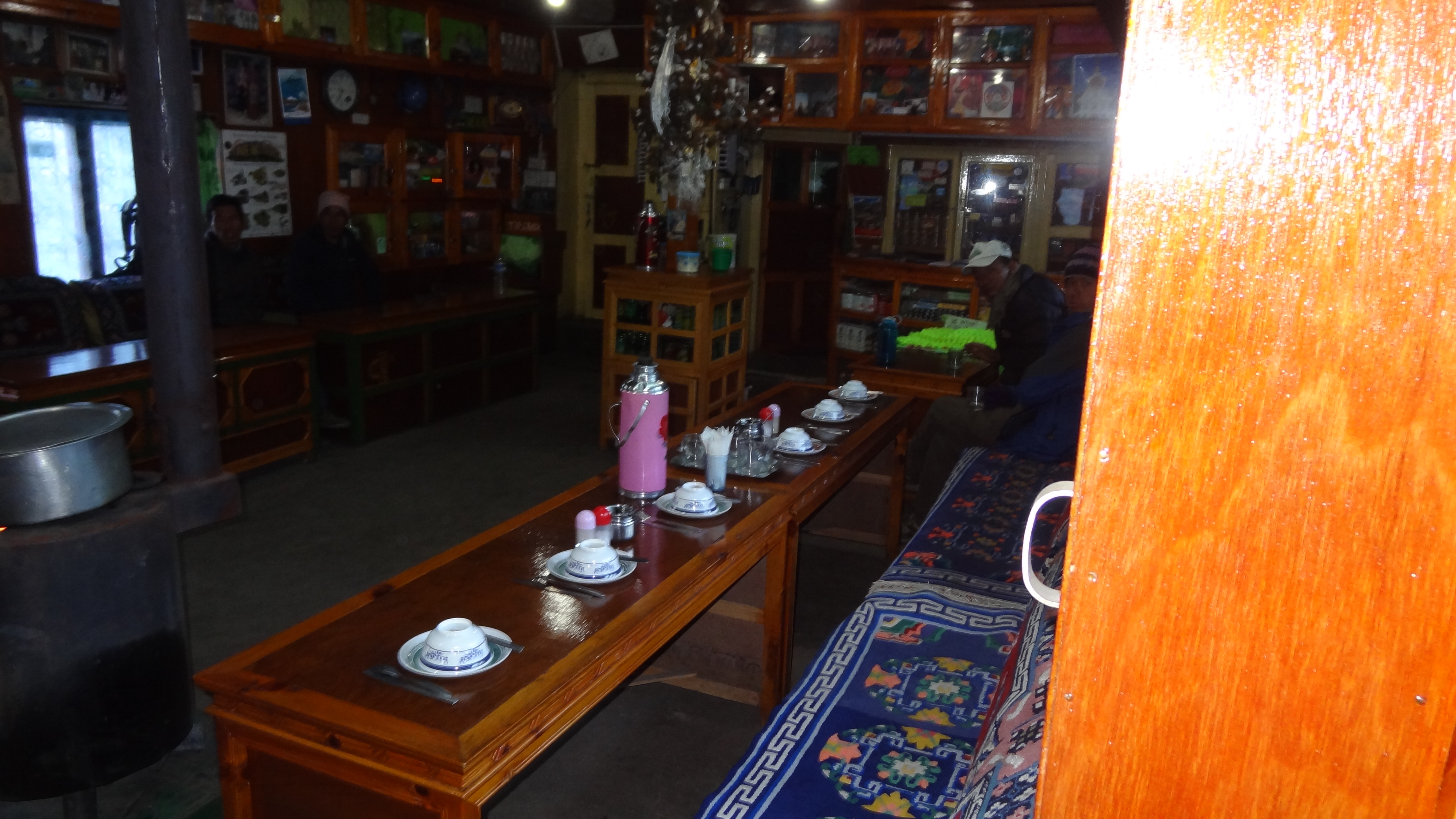
Dining room in the Namaste Lodge - yak dung heater essential!

After a dinner which was as welcome as the earlier shower, we had the briefing for the following day. Tomorrow’s walk is a tough one, both in terms of distance covered and most particularly (combined with) the altitude. We will leave for Dingboche, at 4,400m (14,500 feet) at 7am. Hopefully we are blessed with the same clear skies as we have had for the first four days. We must be due some bad weather at some point, and I just hope it holds as long as possible.

Today’s walk was simply the best day’s walking I have ever done. I may have better to come, but even if I don’t, I will always treasure this one very dearly. I feel so very blessed indeed. In fact it can’t get any better than this – can it?
Himalayas Day 4 – Phakding to Namche Bazar, or ‘The Day I First Got to See Mount Everest’

Having been doing this blog for about two years now, there are certain times when you are going to put up a post and you are quite excited about what you are going to write about. And then there is this one, which would be the most excited I think I have ever been about a blog post. As you can see from the title above, this was the day I got to see Everest, simple as that……

It is so cold in the room when we (Rob, my roommate and I ) wake up that even I am cold (and I am practically never cold at all), and we didn’t even open the window last night. I was very toasty in my sleepy bag though, and really didn’t want to get out of it when the porters came knocking at 6am with bed tea. I hadn’t expected the bed tea, as I thought that was a camping only ritual, but I am very happy to receive it. I start also to worry about how cold things will get later in the trip if it is this cold at only 2,600m.

This is our first night of waking up in the Himalayas themselves, and what a day it is to be. We have a big trek, and a big ascent ahead of us, and a few views to take on board along the way.

So after packing our bags we are given a nice breakfast of porridge and toast, and are almost straight on our way (after paying the bill in the lodge, which is a bit of a faff, but never mind) for our trip to Namche Bazaar. We will today ascend over 800m, and be at a place where the effects of altitude will certainly be felt, hopefully with not much more than a mild headache and increased heartbeat.

The day starts cold and clear, and thankfully is to stay clear all day, but get very warm when the sun hits us a few hours later. We start off in fleeces and hats, but after a while are down to T shirts, and the bottom half of my walking trousers are unzipped.

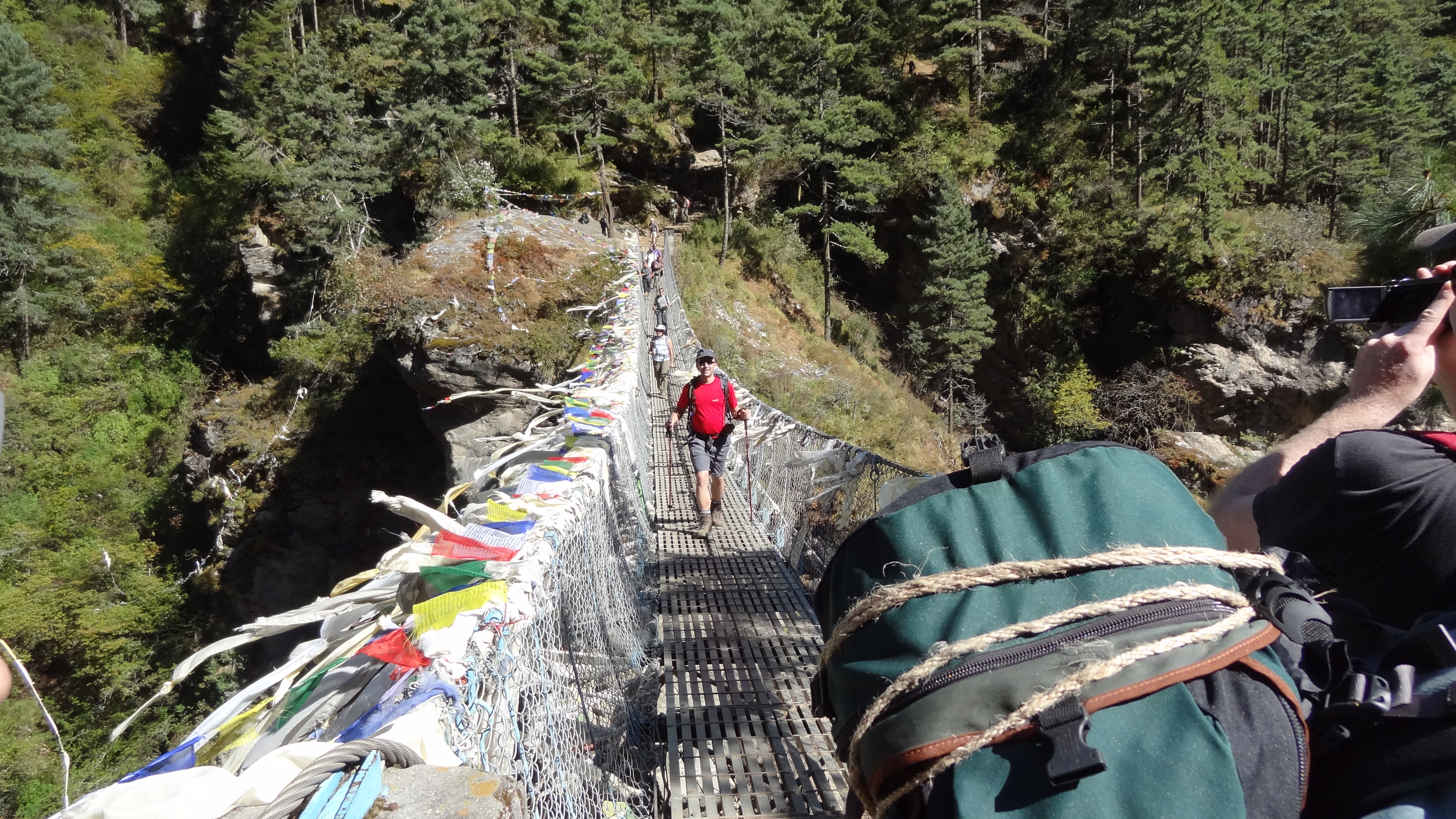
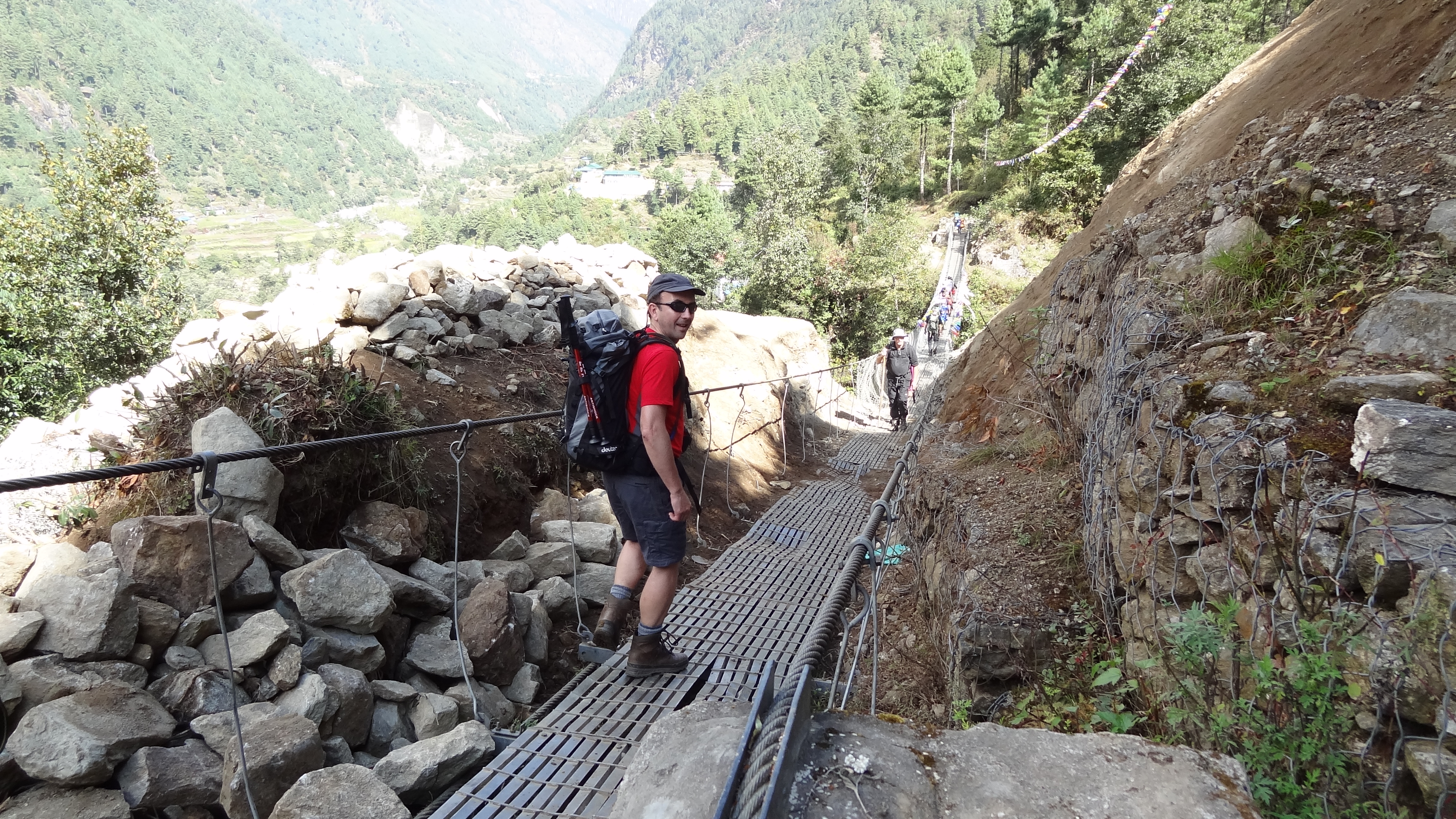
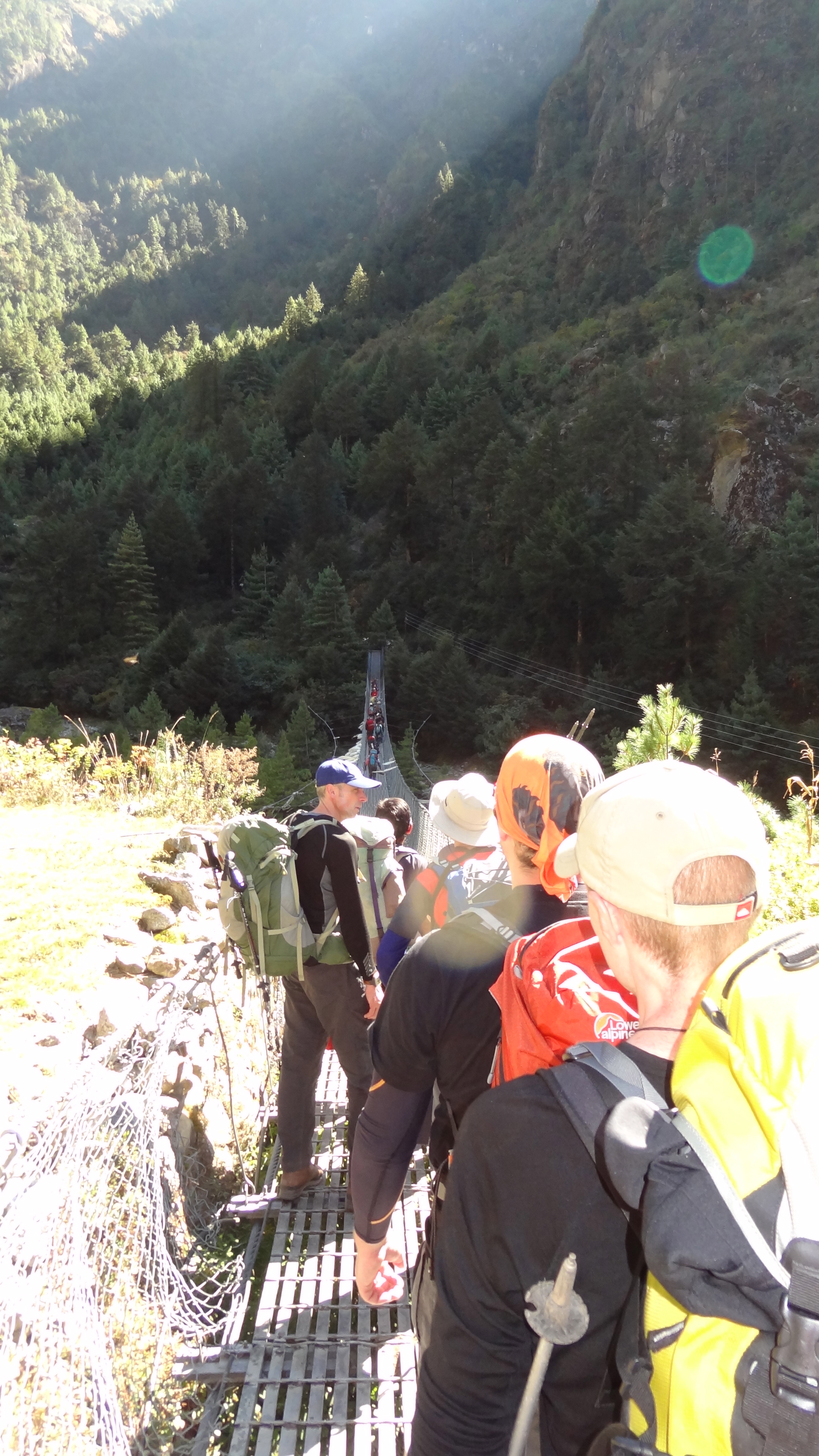
The path is good and actually very pretty in places, being mostly wooded and along the Dudh Khosi (Milk) River. The river is glacial melt water and bright aquamarine almost all the way. Very soon after setting off we hit our first suspension bridge of the day. I thought I was going to be a bit nervous going over these, as they sway, some are pretty high, and are both long, narrow (like three feet wide) and fairly precarious in places, but I passed all with the overriding emotion of enjoyment. I have never done anything like that before, and it is simply a thrill.

The walk begins along the Dudh Kosi River

The first of about five suspension bridges to cross on the day.

Imagine for example the experience of walking about two thirds of the way across a 200m suspension bridge, only to then have to turn back altogether because you have a yak train coming at you the other way! I thought it was absolutely brilliant.

After about three hours we stopped for a delicious lunch of fried noodles, reminding me that we are actually remarkably close already to the Tibetan border. Then it was off to our final suspension bridge, a shorter but really high one this time, which is at the confluence of the Dudh Khosi and Khumbu rivers. We are thus now at the head of the Khumbu valley, and these waters flowing below me are coming from Mount Everest, the Khumbu being the name of the massive glacier which comes down off Everest’s south face.

The last bridge to cross before the climb to Namche Bazaar.

Probably best not to look down. I didn't.

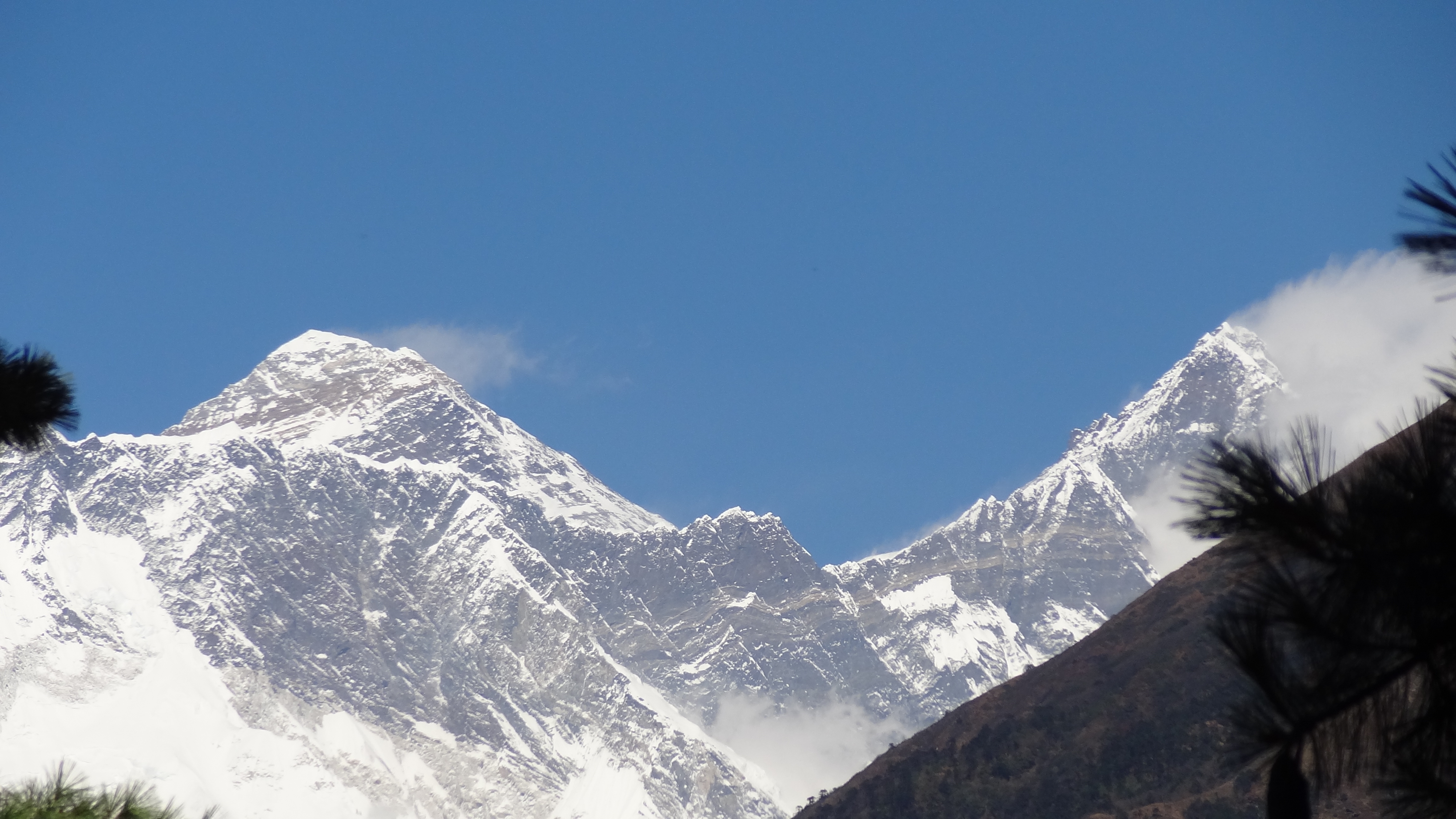
We then head up the steepest part of the walk, and it is a really tough pull. We are rewarded though with the best possible prize for our efforts – for there, after about an hour, and only for a very fleeting moment as a gap through trees and between valleys emerges, is the view I have been waiting for. Everest! It is only the summit, and it is a long way away (about 25 miles I believe from here) but this is the very reason why I am here.

The very first distant view of Everest!

I cannot even tell you what this does to me as far as an emotional experience is concerned. I can tell you though that as I write up these notes, four hours after arriving at my destination, I am actually dripping tears onto the keyboard. Best of all, I see Everest (8,848m, 29,028ft) flanked by Lhotse (8,501m, 27,890ft) the fourth tallest mountain in the world, and Nuptse, a giant herself at 7,800m. Better than even best of all, is that Everest has her magical and iconic plume on show, a trail of snow vapour blown from the very summit ridge, as if flying a massive flag to let everyone know that she, Chomolungma, the Mother Goddess of the Universe, is looking down on you.


Everest (left) and Lhotse, (right).

From this moment the day could only be anti-climactic, but it was all actually great. The walk from there to Namche Bazaar was still around two hours away, and a tough slog, but very rewarding when we arrived.

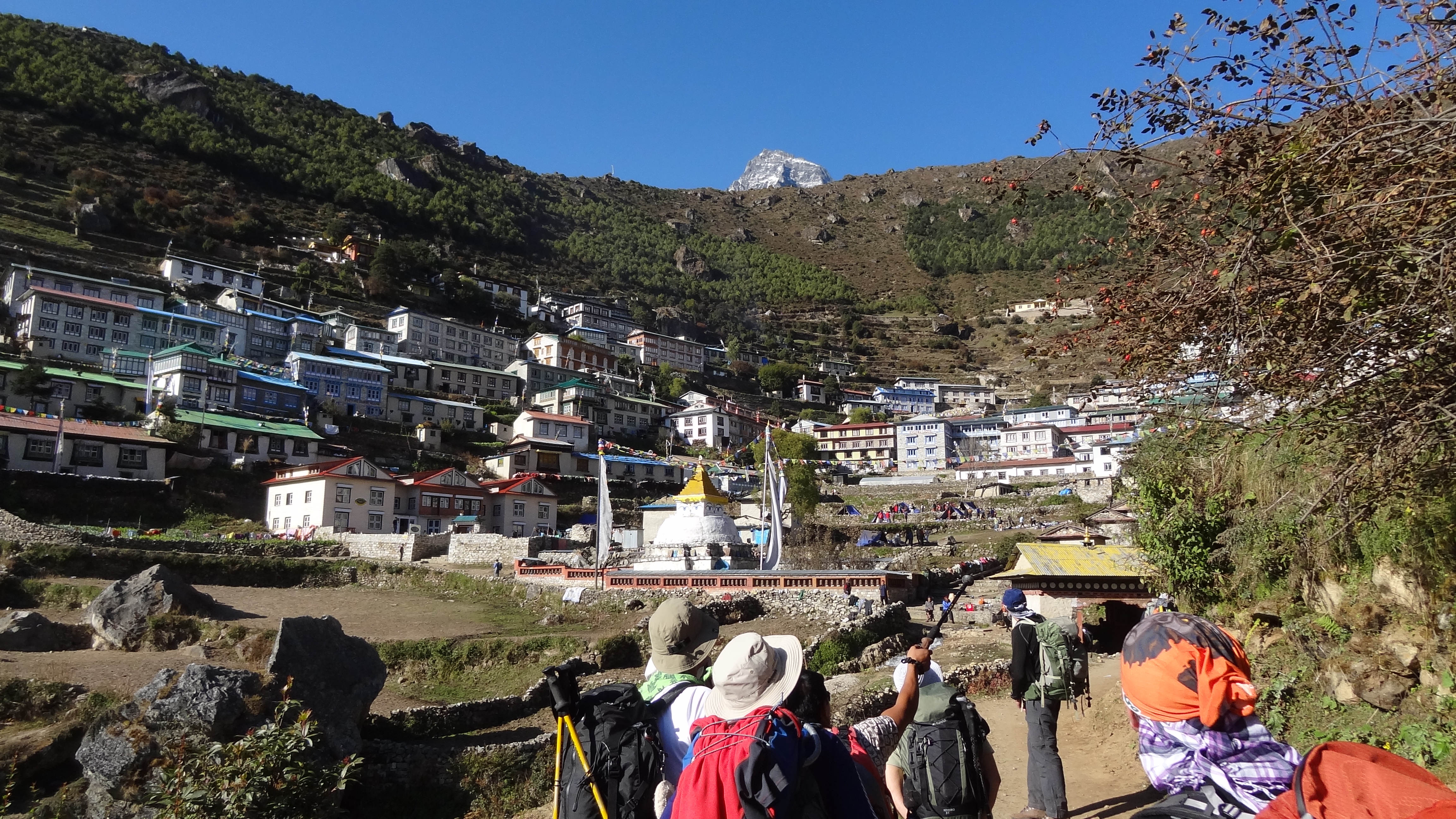
Namche sits in a big bowl, surrounded by giant peaks, and perched on the hillside at 3,440m. It is a market town, a place on the great trade route between Nepal and Tibet, and many Tibetan traders come here to sell goods to locals and to trekkers alike. It feels just amazing to be here – is truly is a different world.

The view coming into Namche Bazar

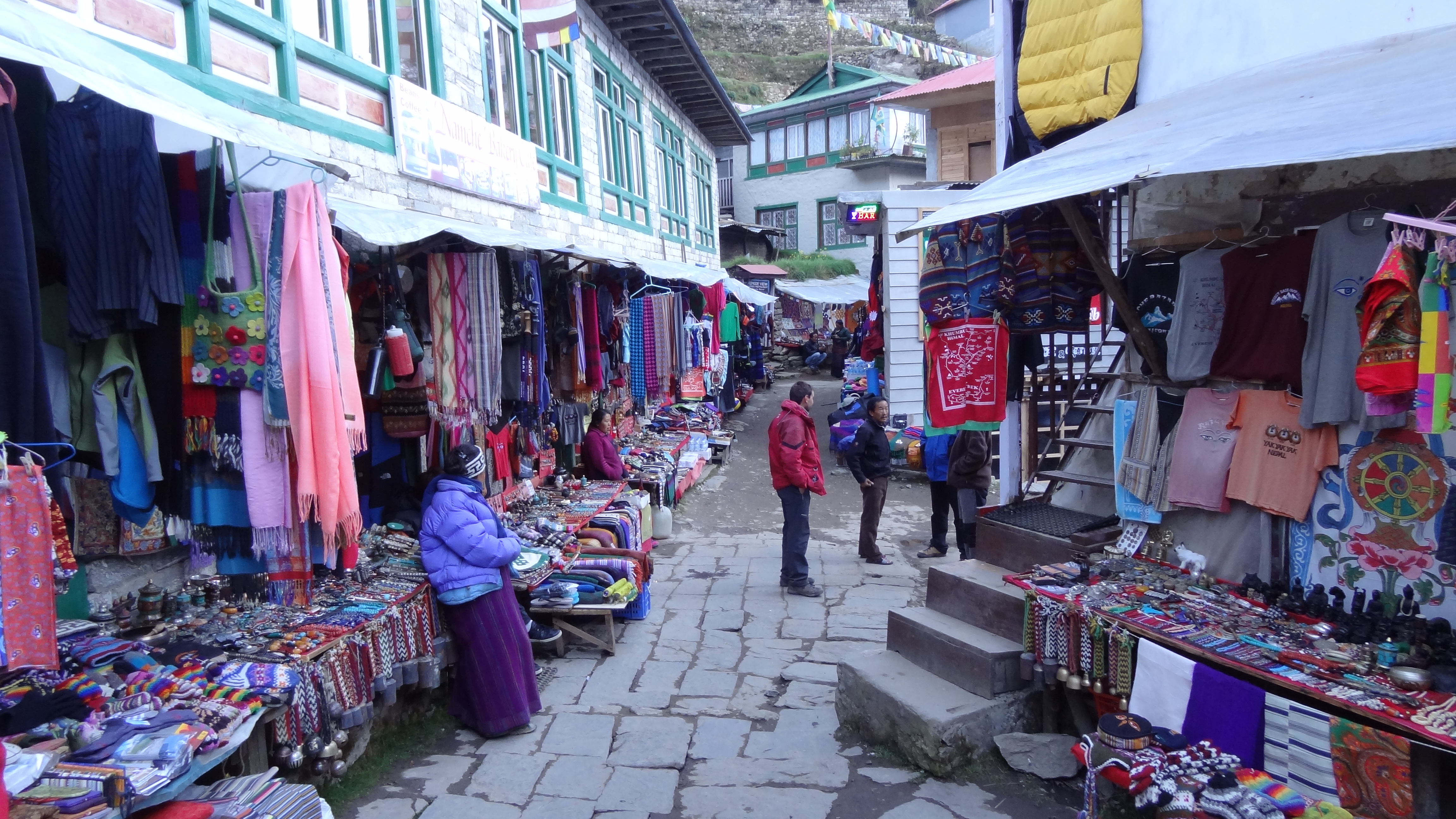
You can in fact buy seemingly anything in Namche, it has wall to wall shops and market stalls, Internet cafes, and bars. You could probably get fairly high just walking around the streets also, as it has a let’s say “evocative” aroma in the air.

A typical street In Namche Bazar, 3,440m

We find ourselves eventually at the ‘Hotel’ Tibet, a four story building at the top of the town. The rooms are basic but fine, although the lack of hot water is disappointing as I thought this might be a place where I was able to take a shower, but alas not. Cold water at below zero temperatures doesn’t entice me to part with my clothes, so they stay put.

Dinner at seven is followed by our briefing for the following day. It is basically an acclimatisation day, as we are now at altitude and must get acclimatised before heading higher to prevent AMS. We will have a great day still though, trekking to a place called The Everest View Hotel, and then onto a place called Kunde, where the major hospital of the Khumbu region was commissioned and part funded by Sir Edmund Hillary. We will do around 350m of ascent and then come back down to a place called Kyangjuma at 3,700m, where we will spend the night.

But today, which is the 23rd October 2011, is a day I will never forget. I got to see Mount Everest. I will get, I sincerely hope, much closer, clearer and better views of Everest as the trek goes on. They may well floor me more than today’s did, and in fact probably will. But nothing in the world can take away from me the fact that today, with my own eyes, I saw her for the first time, and she is undeniably the most magnificent thing I have ever seen.

Himalayas Day 3 – Kathmandu/Lukla to Phakding

Day three is what it is all about. The start of the trek proper! I wake at 4.45am in the hotel in Kathmandu and jump straight into a freezing cold shower and therefore straight out again. It may be my last shower for 18 days, and so it is very necessary and welcome nonetheless!

Everyone is in breakfast shortly after 5, and before we know it our bags are loaded onto the bus and we are off to the airport. The skies are clear, which is great, as if they are not, or it is windy, then the plane will simply not take off. This is a journey on a twelve seater plane, pictured below, to the world’s shortest runway, at just 250 metres. It is also christened ‘the world’s scariest airport’ as the pilots fly directly at the side of a mountain, to a runway banked at 15 degrees. They have to land the plane in exactly the right spot, and get one chance at it. If they miss, it is curtains, simple as that.

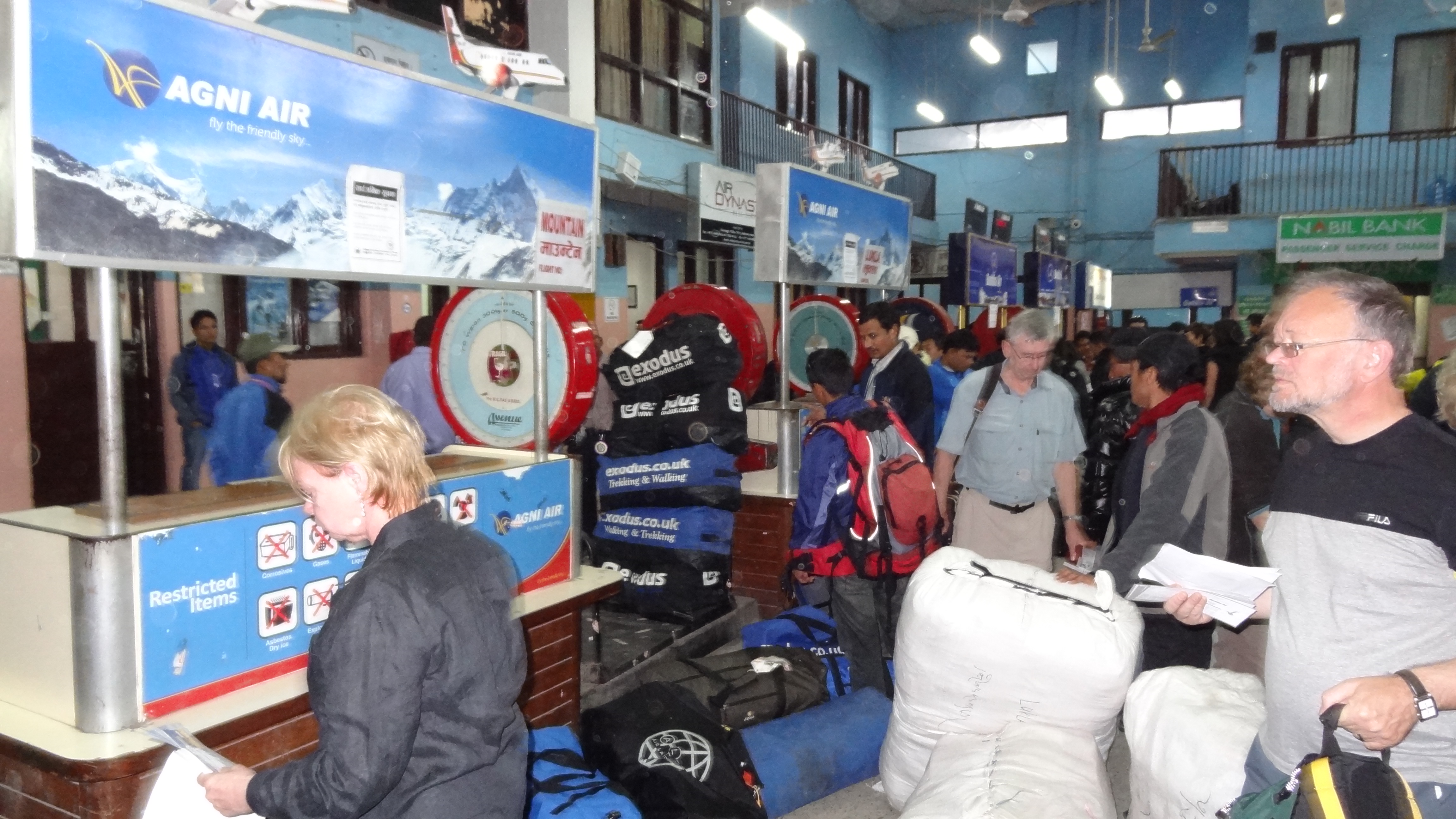
Our bags get loaded and weighed for the flight to Lukla - 12kg seems to have gone out of the window.

And our plane, A Dornier, to fly us into the Himlayas is duly loaded.

If I said I was nervous before and during this flight, it would dramatically understate the facts. Despite this, the flight was breathtaking, pure and simple. We are greeted with almost instant views of the snow-capped Himalaya, the sun glistening beautifully from the ice bound caps of every one, their names unknown to me, but their majesty unparalleled on planet earth. We are too far away still to see as far as the 8,000m peaks yet, but there will be plenty of time to see those, including the greatest of them all, over the coming days.

I don’t think I knew just how vast and amazing the Himalayas would look upon first viewing, but I was just staggered. It is one of those moments that just make you smile and be aghast at the same time. These are the moments that I am here for, and I am so overwhelming stunned by the views that I cannot wait to get closer to the mountains themselves, and I can scarcely believe at I will start walking into them literally in a matter of an hour or so’s time.

The snow-capped Himalayas come into view for the first time.

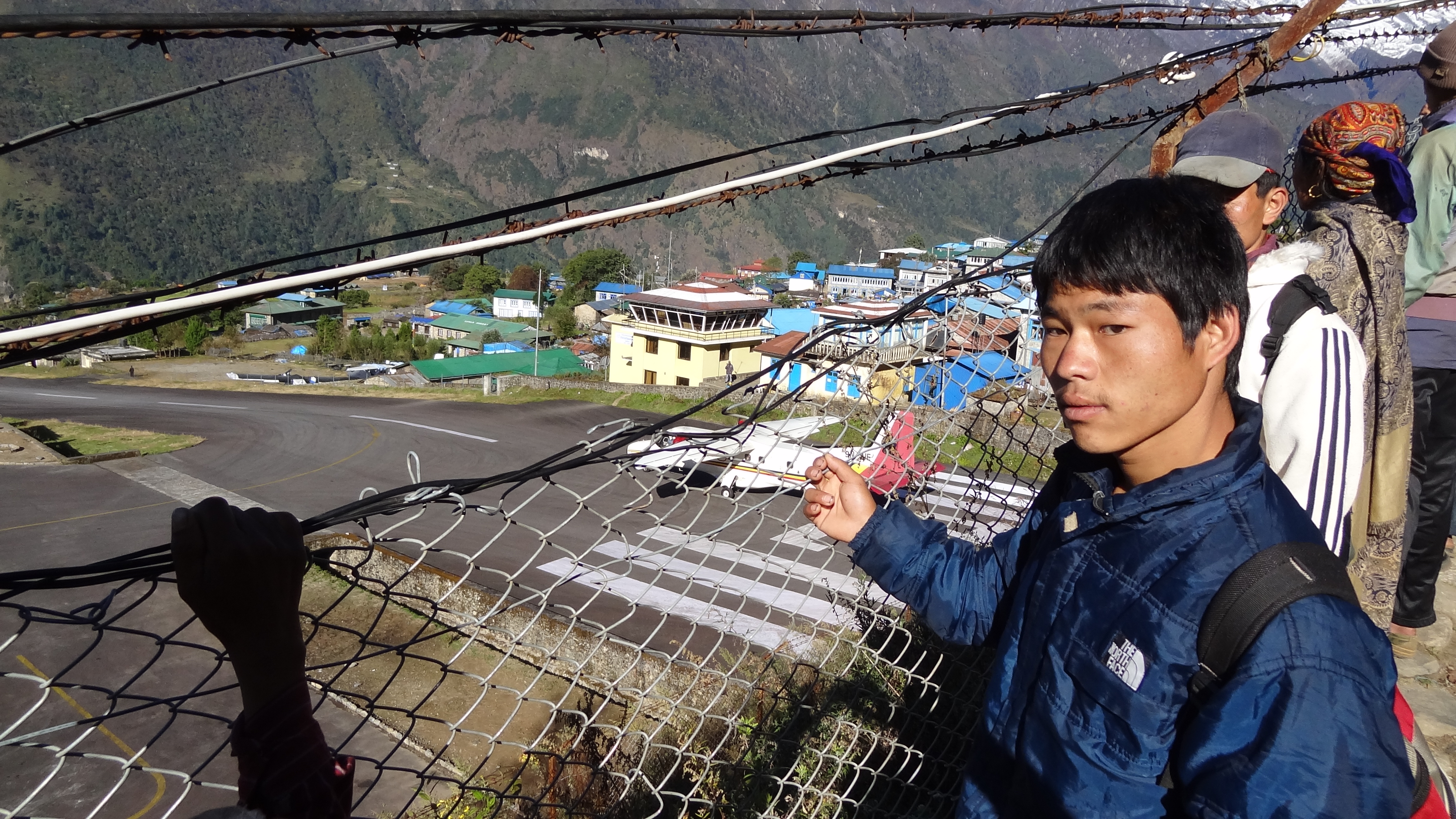
The flight takes just 30 minutes, and then the runway is fast approaching us. It looks like we are heading face first into it, so steep is the descent and so banked the runway itself towards us. Almost before we know it, or have too much time to think about it, we are somehow on the ground, and braking hard uphill to quickly bank right to the front of Lukla airport, which is no more than a stone hut. Around the runway are seemingly hundreds of Sherpas, all looking for work from each successive arrival of tourists. In peak season, which we are in, up to 100 flights a day will touch down here.

On the ground in Lukla - and yes the runway really does slope a long way!

We assemble the kit bags and after a bit of shuffling and reshuffling we are on our way. I have a moment’s panic as my new hastily bought (fake, from a backstreet shop in Kathmandu yesterday) camelbak seems to not let any water out through the mouthpiece. I am about to have a hissy fit and throw it off the edge of the mountain, but Mo takes it from me and manages to find that there is a sort of hidden valve there, and she gets it flowing. Thanks Mo 🙂

The first day’s walk is actually a net descent of 200m, to a place called Phakding. We have flown up to 2,800m, and to start going up further would be to risk feeling the effects of a too sudden ascent, so the trail (for all Trekkers heading to Everest in fact) takes them down this path on day one. It is a short walk, punctuated most memorably by several suspension bridges.

My first suspension bridge, the first of about 10 or so en route

Within minutes of being on the trail, the emotions of what I am doing, where I am, quite hit me. It is now very very real, I am here at last, on the trail, and as early as tomorrow I should get my first glimpse of Chomolungma.

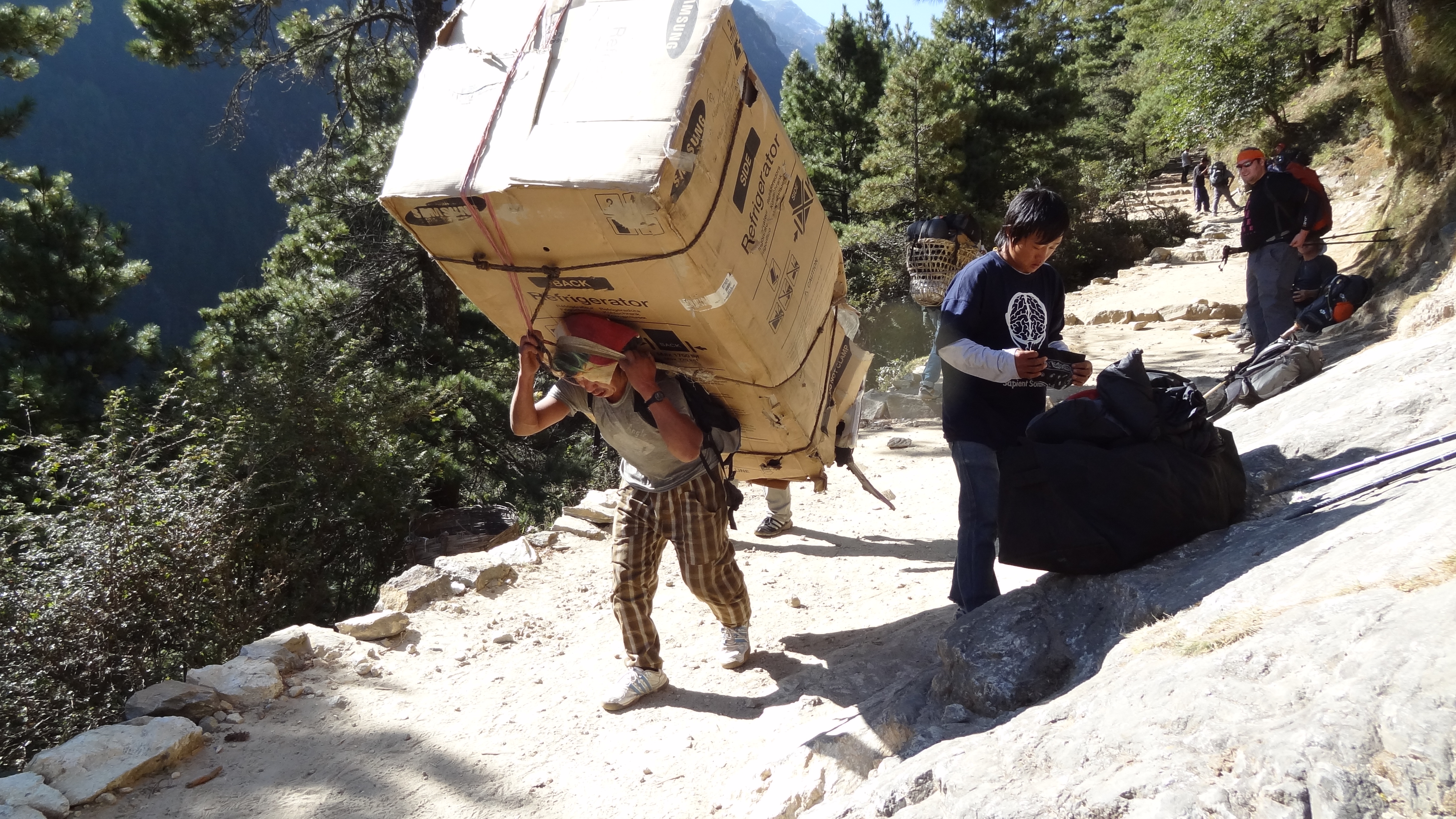
The track is incredibly well laid, of mostly stone path and dirt trail. All the way we are passed in both directions by the incredible Sherpas.  They can carry considerably more than their body weight, sometimes up to about 120kg, or 290lbs, strapped to their head!

You cannot believe some of the loads these guys carry.

We are also passed in the opposite direction by seemingly endless djo trains and also mule trains. The djo is a cross between a yak and cow. Higher up we will see yaks, but they cannot survive down at this altitude, so their shorter haired relatives are deployed here instead. We learn that you must always let the djos and yaks pass you on the ‘down’ side of the mountain path, as they never stop, and you really done’t want to shoved off the mountain by one of them.

The djos carry the bulk of our luggage up the mountain.

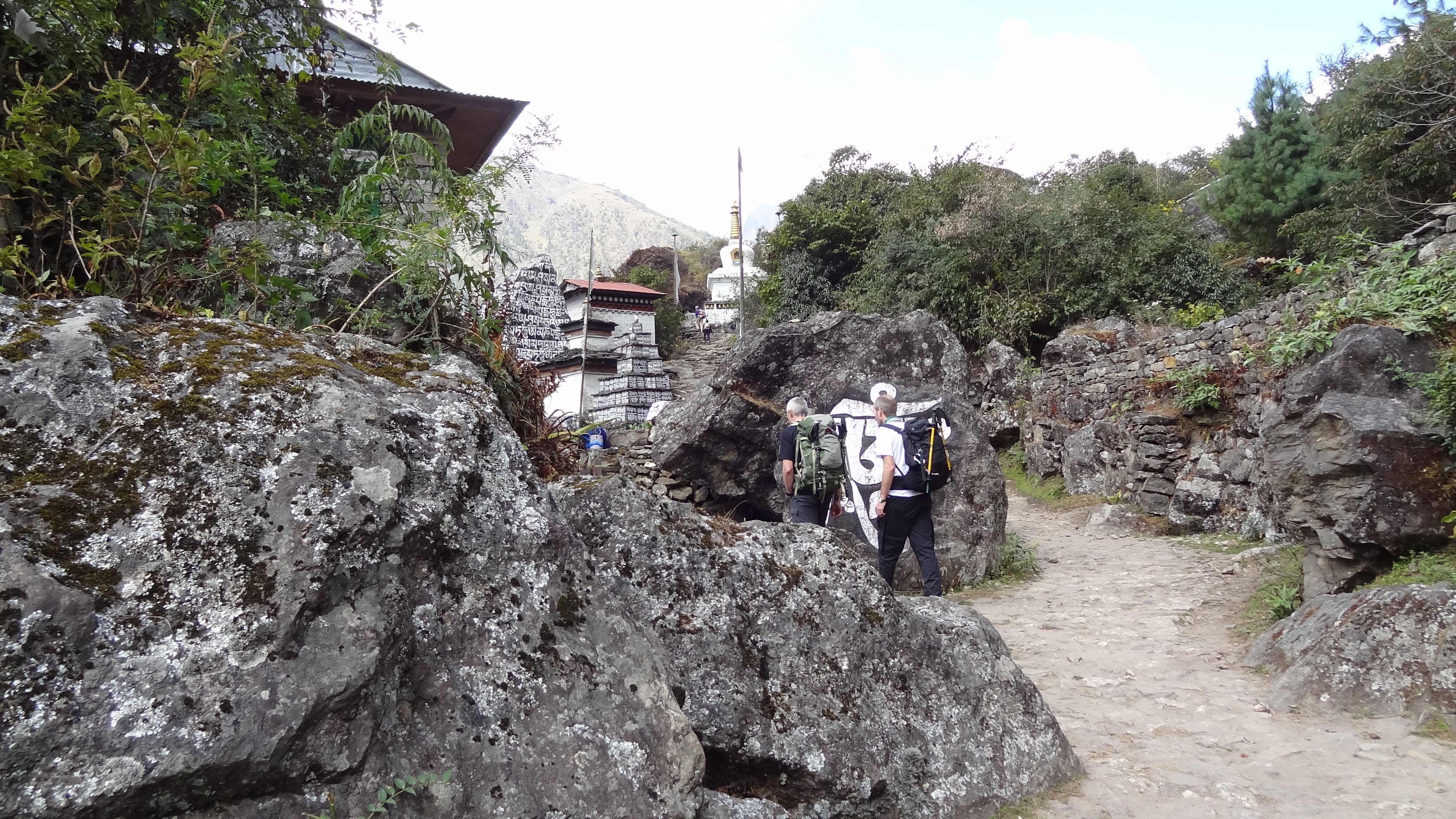
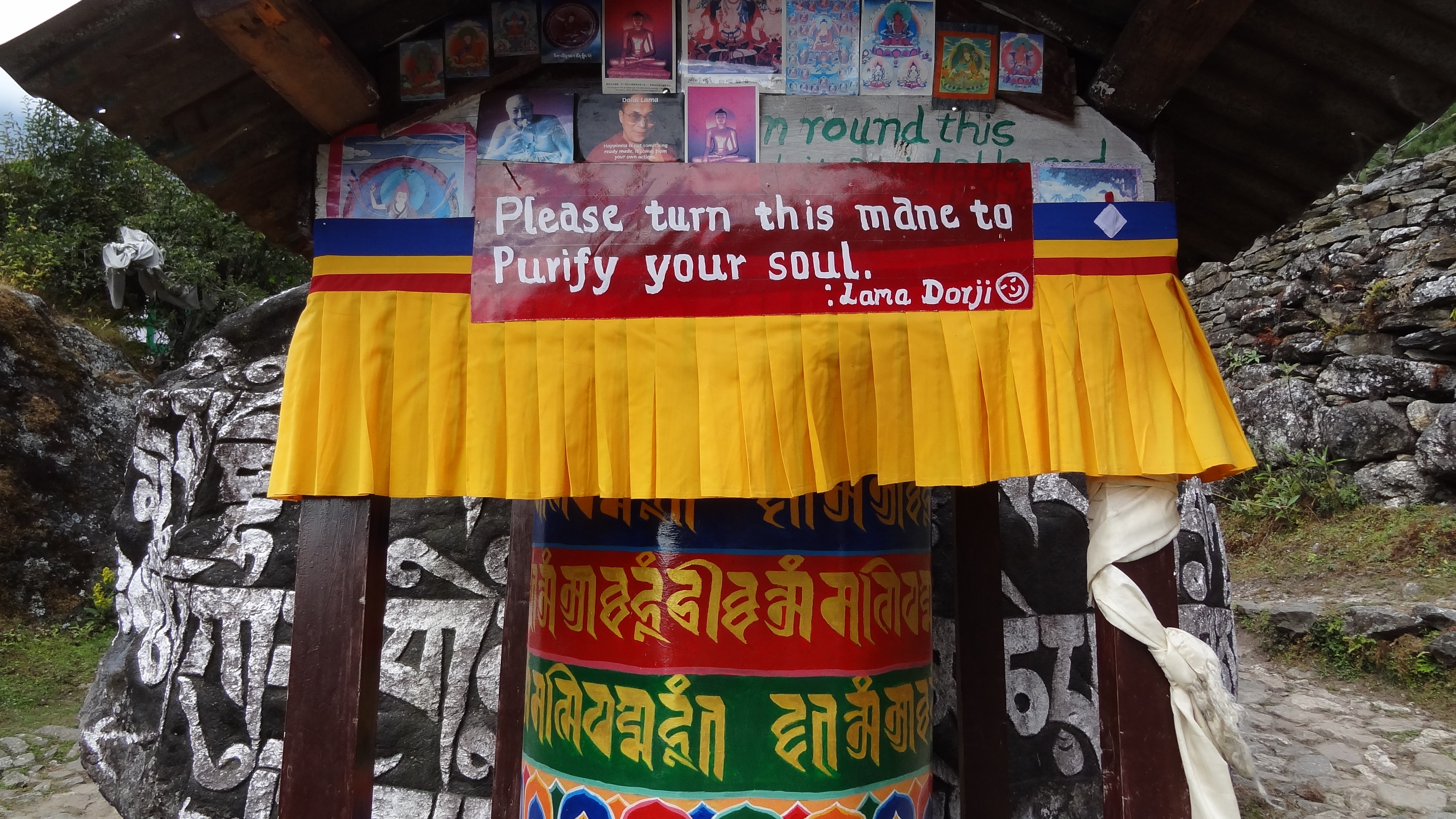
The walk also sees us pass our first prayer flags, prayer wheels, and mani stones. The mani stones are basically prayer messages in the Tibetan/Buddhist faith, and take the form of often very intricately carved tablets, or are sometimes just carved onto bigger rocks. You must pass any of these to the left for good luck, as this is the direction of the earth’s rotation. You can also enhance your blessings and good karma, and keep away from negative influences by spinning the prayer wheels (three times is recommended).

Plenty of mani stones line the route from Lukla to Phakding

A prayer wheel, with various blessings attached.

The views all around are amazing. Towering peaks loom in the distance, although as yet only those to about 6,000m, as the valley that we are in, that of the Dudh Khosi, or milk river, obscures those further up and further away. We are probably within about 30 miles or so of Mount Everest at this point in time, our overall walk there and back being bout 70 miles or so.

Mountains only giving glimpses of themselves at this stage of the walk.

The weather is beautifully warm and sunny, and I walk with my lower pants zipped off, and just a T shirt, although when the sun hides behind the valley walls it feels a bit cooler. Everything is also very lush, the summer monsoon having only finished a few weeks ago. Other than the glimpses of faraway snowy peaks, sherpas and the yak trains, we could be hiking almost anywhere. There is green grass, lush vegetation and abundant flowers and trees.

The walk takes just around four hours, including a lunch stop, and we are here at Phakding in the early afternoon. We are to stay at the Tashi Tagey Tea Lodge. I am very pleasantly surprised when entering the lodge – the bedrooms are nice and spacious and clean, the eating area quite cozy and homely. It is far nicer than I had imagined. I was expecting a stone hut with a cold stone dormitory, and a yak dung stove. Maybe even donkeys or a manger or something too. Perhaps we will see that sort of thing higher up the mountain.

Our group at our very first lodge dinner

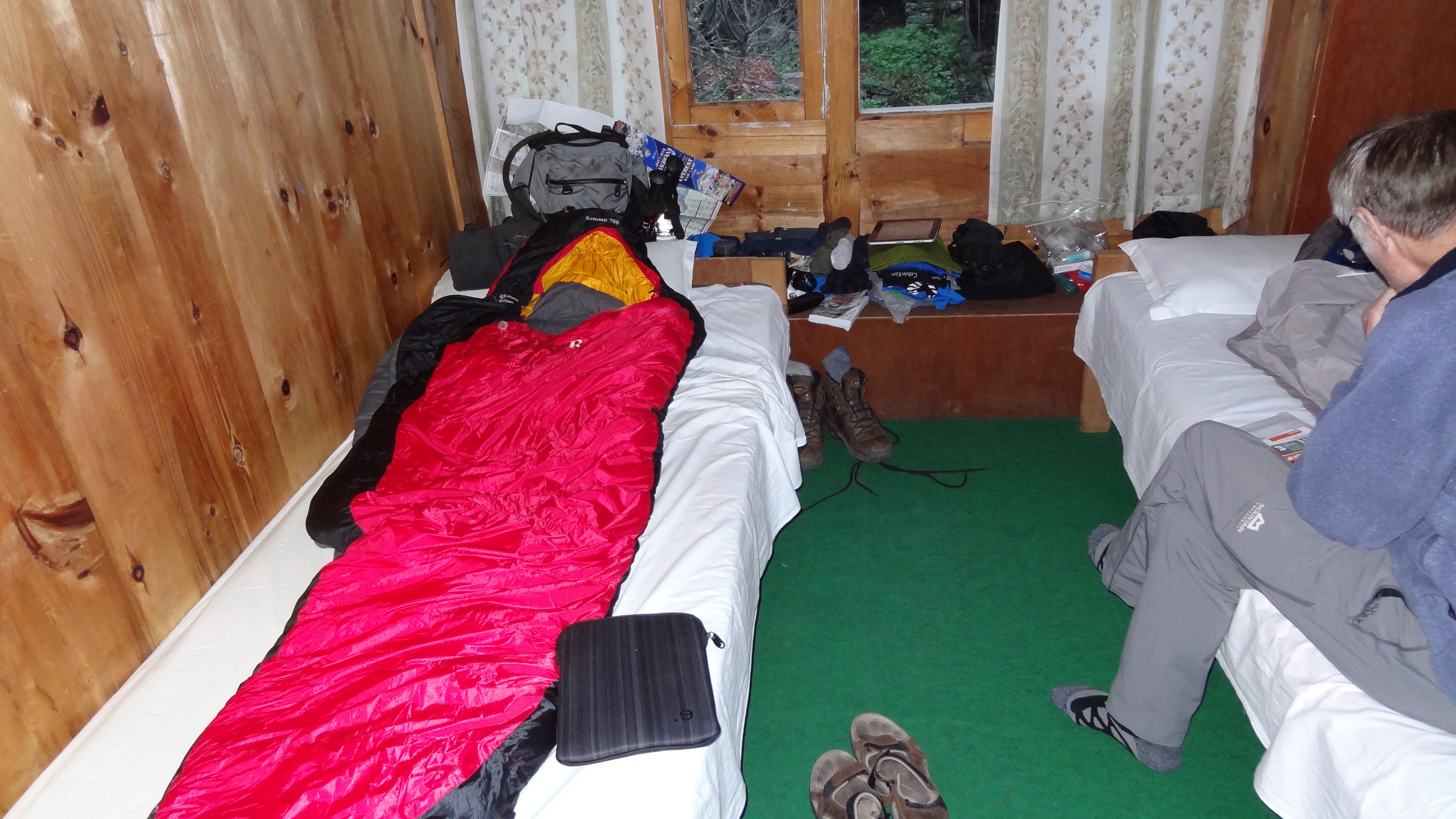
The bedroom in the Tashey Tagey Lodge. I was never very good at keeping my side very tidy 🙂

After a nice relaxing afternoon we have dinner from a menu that we can choose from, and it is great and plentiful. I drink ginger tea, and look wistfully at the bottles of beer on display at albeit stupidly high prices. I would love one, but decide better of it. By tomorrow we will be at 3,500m, and the onset of potential altitude headaches or worse will me upon us. We will need to drink around four litres of water a day to hopefully stave off the effects of AMS, and to drink alcohol at this altitude is foolish at best. I am now therefore on the wagon for the next 18 days, which can’t hurt me after all, even if it doesn’t sit well with me at the moment.

After dinner of our choosing (I got spaghetti with tomato sauce and it was delicious) we get our briefing for the following day. We will be walking for around 6 and a half hours from here to Namche Bazaar. That very name has excited me ever since I first heard about it on the trip notes.

We will tomorrow alone apparently cross 5 suspension bridges, the last two of which are very high, and then there is a very steep path, where at some point we should catch our first, but fleeting view of the thing I came here for – Everest! We all troop off to bed around nine and will have an early start at around 6.30.

The trek is on, and we have completed our first day in the foothills of the Himalayas. I am so excited about everything that I will see higher up, and this day is a great (and also nice and easy) taster for it all, and yet I have already seen and learned so much. I hope I can sleep…….

Everest!!!!!!

The phrase “there are simply not enough superlatives in the English language….”, is one which I feel is becoming overused these days. I quote this because I hear it a lot, and heard it recently whilst watching a video of Michael Palin’s fantastic “Himalaya” series on DVD. He used it when seeing Everest for the first time, and I can only say that I hope to join him in coining that phrase for myself.

Today then is a landmark day in my life. I have decided that I will trek to Everest base camp, come what may, hell or high water etc. It has been brewing for some considerable time of course, but today was the day that did it. I may look back in years to come as to what catapulted my thoughts into this state of dedication to the mountain, and so I should write them down here, for posterity if nothing else. They will follow in later posts.

The decision making process has been going on for some time I should say – maybe even for years, but recent events have got me to where I am now.

Everything was ultimately so complicated though, and so more of that in later posts too.

In recent weeks I have read several books on the 1996 Everest disaster, in which 12 climbers lost their lives. The books by Jon Krakauer and Anotoli Boukreev tell quite vividly different accounts of an awful and frightening occasion, and what they both did for me was make me want to climb the mountain. Yes CLIMB. I can’t climb a tree, but that’s what they make me want to do. That is where I got to with Kilimanjaro – I felt that the more I read about altitude sickness, and scary stories about how you might die up there etc, the more I wanted to be there.

With Everest it is more than that, a whole lot more. For one I can’t climb it. I am not capable (I have literally no climbing experience whatsoever), couldn’t afford it (it costs around £50,000 for a trip these days, before equipment and flights etc), and certainly haven’t the time (they recommend about 72 days I believe in the region to acclimatise etc. before going up to the top). Despite all that why do I find myself researching climbing trips to not just this but the whole of the Seven Summits?? Well let’s see where that all gets to….

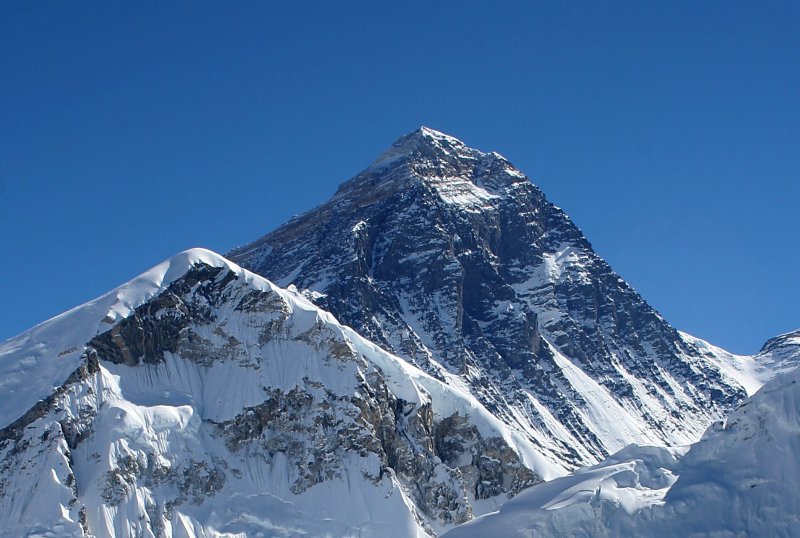
For now I the important thing for me is that I am back on track – the time is now! In the past 48 hours I have deliberated over so many things: Who to trek with? (there are so many travel companies out there); What equipment do I need?; Whether to just do Base Camp or to combine it with another peak (much more of that later…..); Which camera to buy? :); How soon to do it? etc. The most important thing (though very definitely never easy for me) is to concentrate firmly on the most important objective – to get to see Everest, preferably from the ‘classic’ view point, which is apparently from a place called Kala Patthar, from where you get views like this:

Everest from Kala Pattar

I can’t even comment on the above right now – there are no words, let alone superlatives, that could tell you how I would, no, how I WILL feel, when I get to see that for myself.

So when I stared this blog 18 months or more ago, I had no idea when I named it “To Kilimanjaro and Beyond”, what the ‘beyond’ bit might be. Well for now it is going to be to pay a visit to what the Nepalese Sherpa call “Chomolungma”, which translates to “Goddess Mother of the Earth”. Now how exciting is that?